Solving Sudoku Puzzles
Oct 10, 2026
When solving sudoku puzzles, I used to only know the basics - look for cells where only one number can exist, look for the last remaining number in a row, et cetera. These strategies can definitely solve some puzzles, but they can only take you so far. I eventually decided to learn a few more techniques, and found that the number of puzzles I could solve greatly increased.
This is my mini dump of the strategies I’ve learned. I wouldn’t say that 100% of all puzzles are solvable using this set of techniques, but I’d say that it’s a good tradeoff between solving marginally more puzzles and spending too much time learning sudoku tricks.
Strategies
My principle with approaching sudoku puzzles is to avoid using backtracking as much as possible; I feel that the “guess-and-check” behavior of backtracking sort of defeats the purpose of the puzzle.
Basic Techniques
The most basic techniques are those that identify “obvious” cells, where a number must be in a certain cell because either it’s the only possible value for that cell or it only appears in that cell for the cell’s row, column, or 3x3 box.
Spears
This is the first technique I learned, when I was watching my dad do a sudoku puzzle on a plane many years go. I don’t know if there’s a formal name, but I visualize them as “spears”. Within a 3x3 box, if a number is only possible in cells that are within the same row or column, then that number can be eliminated from all other cells in that row or column.
A proof (like almost every proof for a sudoku technique) is by contradiction. If the particular number was placed in the same row or column outside of that 3x3 box, then there would be no legal placement of the number within the 3x3 box, based on our description of the scenario. Therefore, the number must not exist in that row or column outside of the 3x3 box.
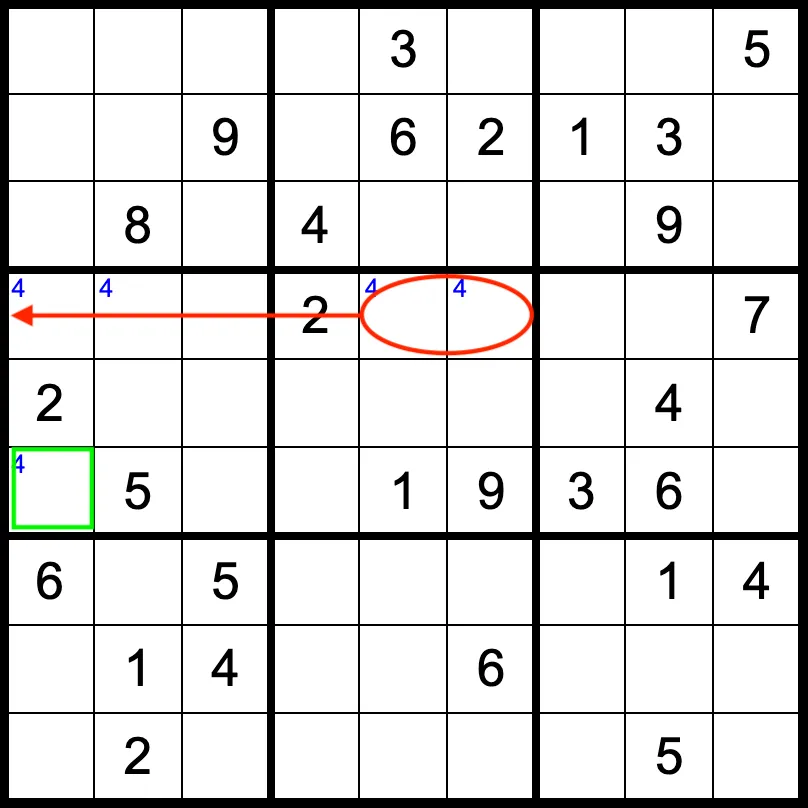
In the above example, the middle 3x3 box has only two cells that could be a 4, and those two cells are in the same row. Therefore, no other cell in that row outside of the middle 3x3 box can be a 4, and so the bottom left cell (green) in the left-middle 3x3 box must be a 4.
Double Spears
This builds upon the spear technique. If there are two 3x3 boxes on the same row or column, and a particular number is only possible in the same two columns or rows, respectively, then that number can be eliminated from the third 3x3 box in those two columns or rows.
In a similar proof, if the number in the third 3x3 box appeared in one of the two initial columns or rows, then one of the two “matching” boxes would not be completable.
Technically, this is equivalent to finding a row or column whose only possible positions for a given number all lie within the same 3x3 box. In such case, that number can be eliminated for all other cells inside that 3x3 box that are not within that row or column.
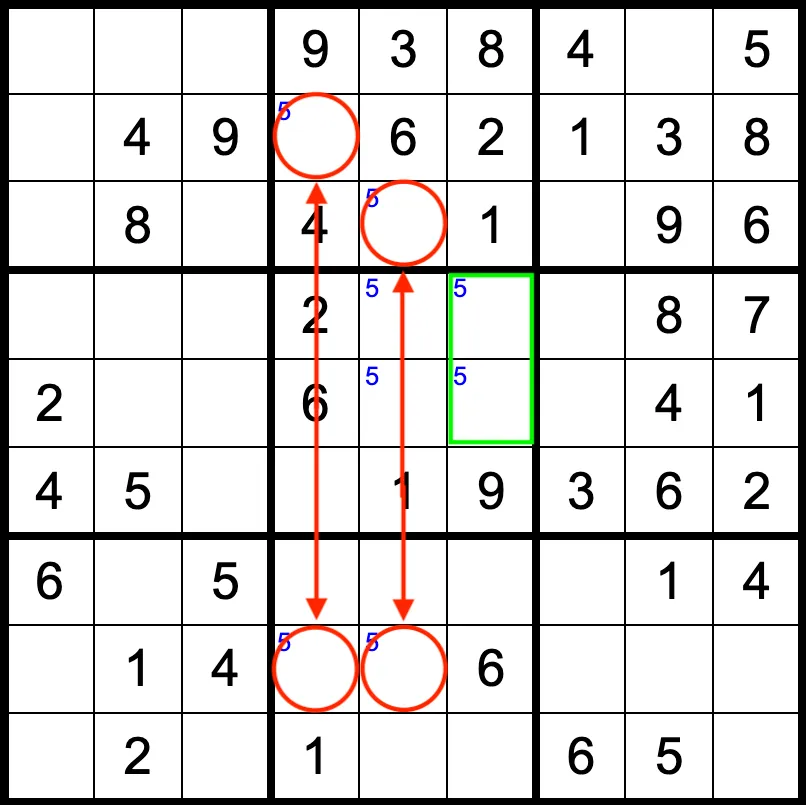
The above example is a continuation of the same puzzle from the single spear example. We notice that 5 appears as a possibility in only the left two columns of the top-middle and bottom-middle 3x3 boxes. This means that we can eliminate 5 from the first and second column of the middle 3x3 box.
As mentioned previously, this is the same consequence as realizing that within the sixth column, 5 can only appear within the middle 3x3 box, and so within the middle 3x3 box it cannot be anywhere besides its right-most column.
Hidden Groups
Hidden groups are one key technique to being able to solve many more sudoku puzzles. Within a single row, column, or 3x3 box, if a set of n numbers could possibly exist in a set of n positions, then all other numbers can be eliminated from those positions.
Naturally, the easiest hidden group to spot is of size n=2, though n=3 is also usually identifiable. Larger groups are harder to spot, and the case where n equals the total number of unplaced numbers in the row, column, or 3x3 box is not useful, as there are no numbers to eliminate.
As proof, consider placing a number from outside the group of n numbers into one of those n positions. You would be left placing n numbers into n-1 positions, which is impossible. Thus, those n positions are only fillable by the n numbers.
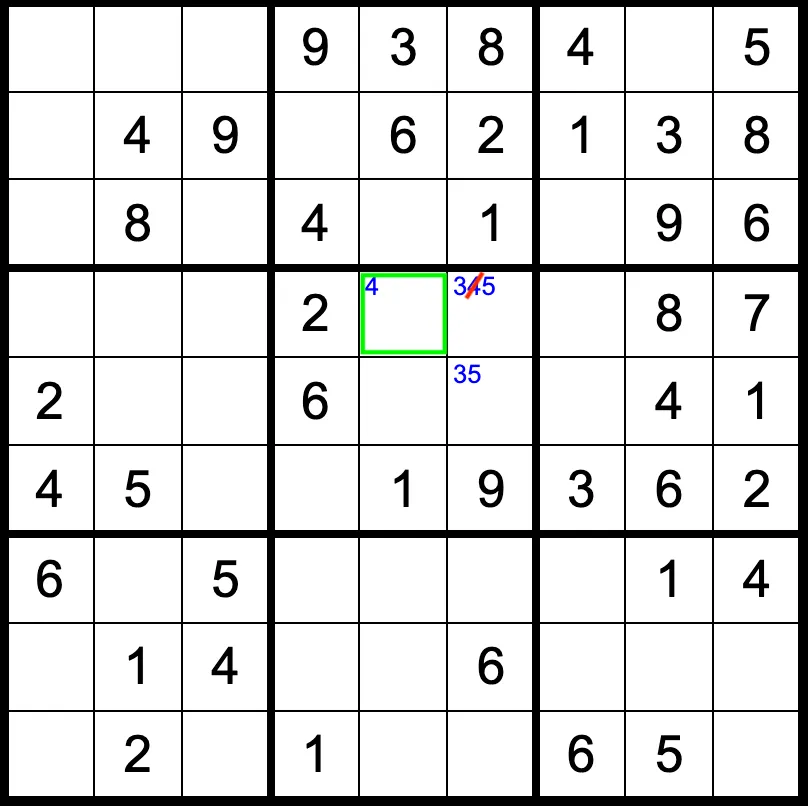
This example (yet another continuation of the ones above) shows a hidden group resolving the location of a 4 in the middle 3x3 box. We know that 4 is a candidate for the top-middle and top-right cells in this box. Using the above strategies, the right two empty cells in this box are the only two possible cells to contain 3 and 5. This is a set of two numbers that can only appear in two cells in the 3x3 box, so it is a hidden group. This means that 4 is removed as a possibility from the top right cell, and so 4 must be in the top middle cell.
Naked Groups
Naked groups are essentially the converse of a hidden group. If there is a set of n positions in a row, column, or 3x3 box whose values are only within a set of n numbers, then those n numbers can be removed from all other positions in the row, column, or 3x3 box.
The difference between the two group techniques is that for naked groups, the set of positions must contain the set of numbers, while for hidden groups, the set of numbers must exist in a certain set of positions. The resulting eliminations also differ; for a naked group, the set of numbers is removed from the other positions, while for a hidden group, the other numbers are removed from the set of positions.
The logic behind this technique is similar to hidden groups. If one of the n numbers appeared outside of the n positions, then there would be n-1 numbers left to fill n positions, which is an impossibility.
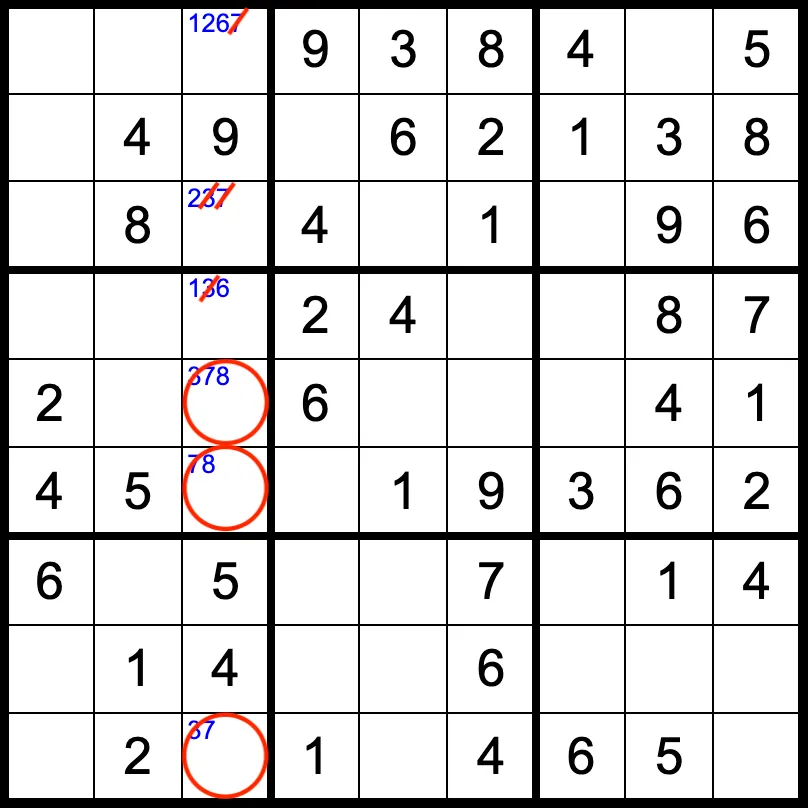
The example (continued from above for the last time) shows that 3, 7, and 8 form a naked group in the third column. Therefore, those three numbers can be eliminated from all other cells in the column. For this example in particular, it reveals that the bottom-right cell of the top-left 3x3 box must be a 2. From here, every other cell in the puzzle is solvable through basic techniques, and the puzzle is done.
X-Wing
The X-Wing technique is among a group of “fish” strategies. Of the sort, it is the most basic, and the one I will cover here.
If there are a set of two rows where a number has two possible cells in each, and those two sets of cells lie on just two columns, then that number can be removed as a possibility from all other cells in those two columns. The case where rows and columns are switched is also true. One can think of this as a 2-D version of an n=2 hidden group.
As proof, consider a row-based X-Wing. Suppose that the number is placed in a cell that is in one of the two columns but is not on one of the two rows. This leaves only one cell in each of the two rows to possibly have the number, but these two cells are in the same column, which is an impossibility.
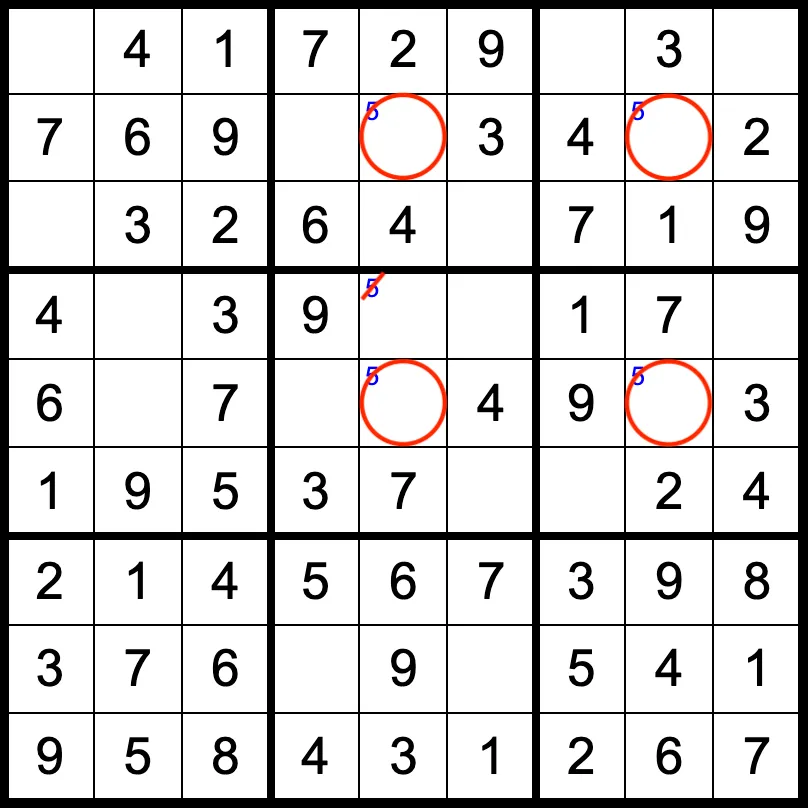
In this particular example (from a different puzzle), a subset of the candidate 5s are isolated. In rows 2 and 5, we see that 5 appears as a candidate exactly twice, and in the same two columns. This is an X-Wing, and so we can eliminate the 5 from the fourth row.
There are other extensions to this technique in the aforementioned “fish” family, and they can grow quite wild. The swordfish is a three-row, three-column variant of the X-Wing, but there exist techniques called the mutant fish and franken fish, and there might even be some concept of “cannibalism” involved. If you’re interested, please check out the various sudoku wikis out there to learn more.
Appendix
Many more techniques exist, but I find them to be more niche (and not necessarily intuitive). If you want to learn more, see the Sudoku Wiki.
I implemented these strategies in a “smart” sudoku solver here: GitHub.